Tokenization projects often begin with a token contract and only later ask what the token represents. For an API team, that order creates unnecessary ambiguity. A token can record a quantity or an identifier, but the surrounding application still needs to describe the asset, relevant documents, permitted actions, and operational responsibilities. An elegant contract interface does not answer every business question.
This guide proposes a design process for a fictional tokenized membership-credit system. The example is intentionally not an investment offering, a legal classification, or a deployable contract. Its purpose is to show how to connect asset records, issuance decisions, transfer observations, and support processes without assuming that a blockchain record explains the entire relationship.
Start with a plain-language asset description
Before discussing minting, write one paragraph explaining what a holder can do with the proposed token. Identify who provides the underlying service, what one unit represents, whether it expires, and what happens when that service is unavailable. A product manager, engineer, and operations reviewer should reach the same interpretation after reading that paragraph.
For our membership-credit example, one unit might represent access to a specified service under separate program terms. That statement still leaves questions: can credits be transferred, refunded, or revoked? Are balances tied to a named member? Rather than guessing, make each unanswered question an explicit design dependency. Do not encode unresolved business decisions into a smart contract and hope documentation will repair them.
Understand the boundary of a token standard
ERC-20 specifies a common interface for fungible tokens, including balance, transfer, allowance, and supply-related methods and events. Its name, symbol, and decimals methods are optional in the specification. Client software should therefore not assume every contract supplies all display metadata, and it should handle unsuccessful calls and boolean return values correctly.
Read the primary reference
The ERC-20 specification is the primary reference for that interface. It does not establish the legal rights attached to an external asset, certify an issuer, or make an asset redeemable. Our design recommendations below address the surrounding application model. They are not additional ERC-20 requirements, and another asset type may need a different technical standard.
Separate asset, program, and token identities
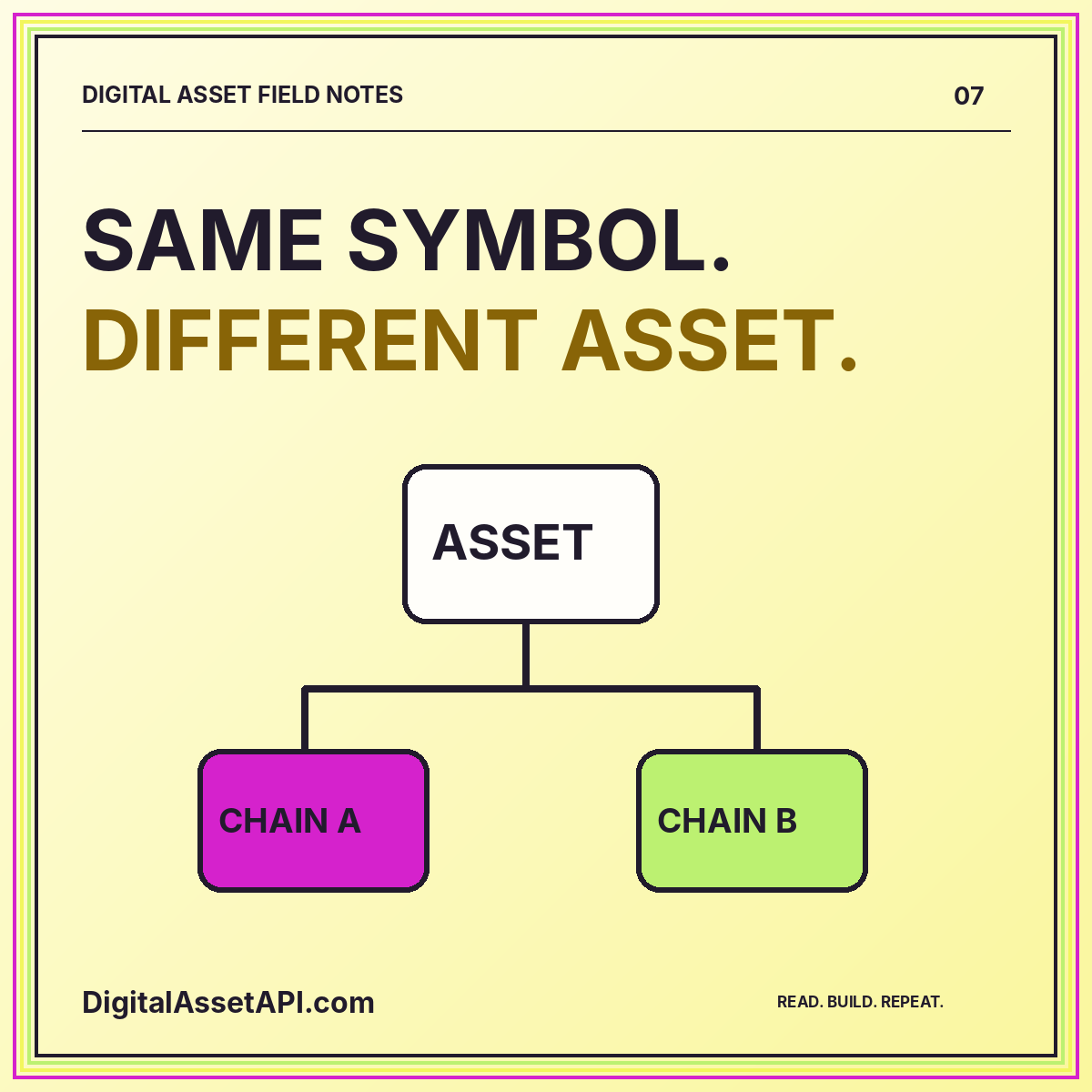
Create an asset record describing the underlying object or service. Create a program record describing the rules and responsible operator. Create a token record containing the network and contract identity. These records should be linked, not collapsed into a single symbol. This structure lets you change descriptive content without accidentally changing the identity of the on-chain instrument.
Imagine the same membership program experiments on a test network and later launches on a production network. Those are separate token records even if their names match. A new production contract should also receive a distinct identity. Record migrations as relationships with effective dates rather than overwriting the original address and making historical observations impossible to interpret.
Version the evidence behind each decision
An issuance decision should reference the version of the program terms and operational policy that applied when it was approved. Preserve those references in an append-only decision history. A later policy update should not rewrite the explanation for an earlier issuance. Reviewers need to reconstruct what the system knew, not merely view today's settings.
Keep sensitive documents outside public token metadata. Your API can return a document identifier, version, and access classification without exposing the document itself. Access to an asset record should not automatically grant access to every associated file. Treat document delivery as a separate authorization decision, with its own retention requirements and accountable owner.
Model issuance as a workflow, not a button
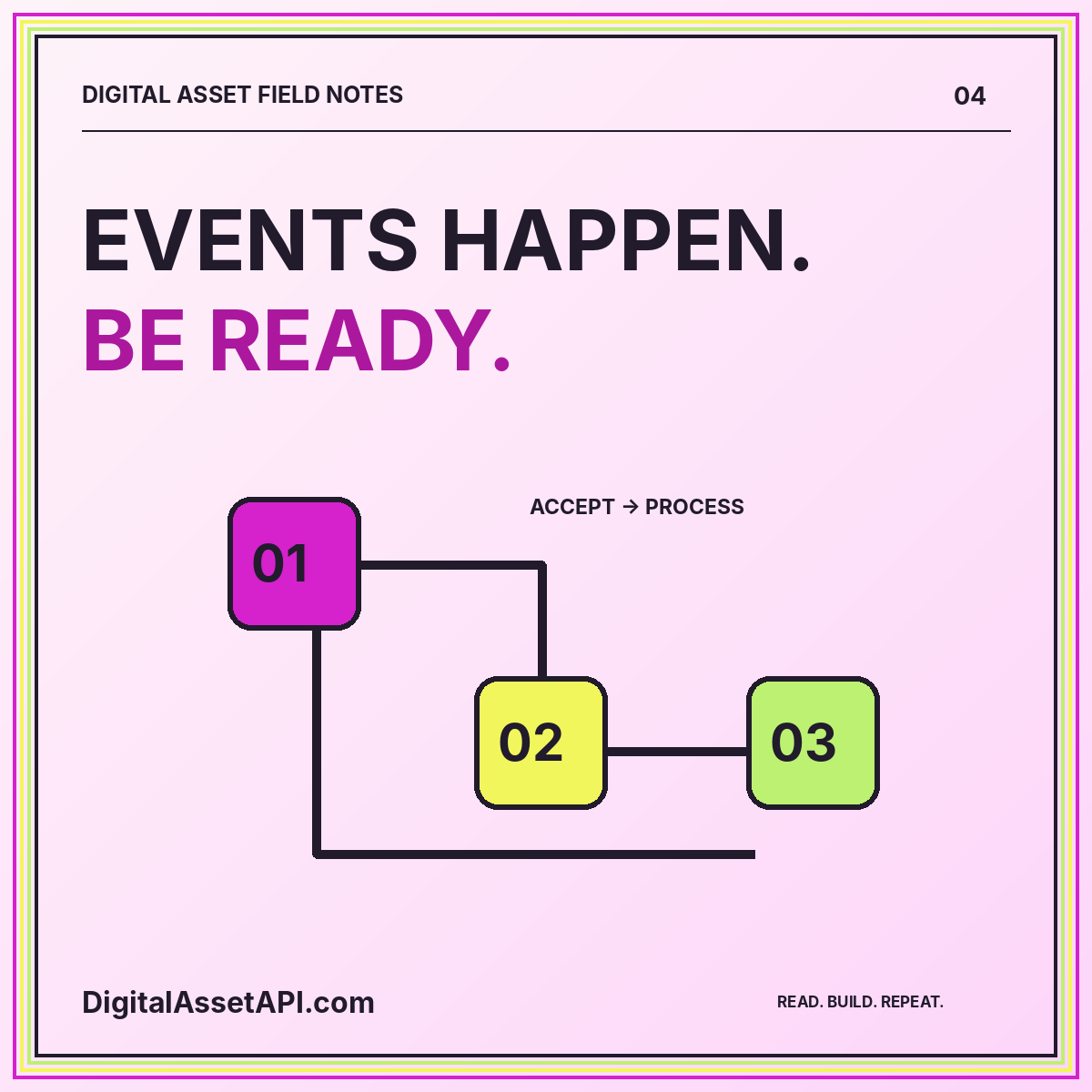
A proposed issuance can pass through requested, reviewed, approved, submitted, and observed states. These labels are an example application vocabulary, not a chain standard. Distinguish the business approval from the blockchain submission. A request can be approved while submission fails, or submitted while the final observation is still unresolved.
Use a stable request identifier for the business action. If a worker retries after a timeout, it should first reconcile the existing request rather than create another issuance. Preserve a link between the request, approvals, submission attempts, and resulting transaction evidence. A transaction hash by itself is not a complete audit history for the decision that caused it.
Keep balances and entitlements distinct
In the fictional membership program, an on-chain balance and an off-chain service entitlement are related but not identical records. A member might hold a token while a service request is awaiting review. The application needs to show both conditions clearly. Avoid presenting an observed balance as proof that every associated off-chain condition has been satisfied.
Define the authoritative system for each field. The chain may be authoritative for a token balance at a specified block, while the program database owns the service eligibility decision. Where two systems disagree, create a reconciliation exception instead of choosing whichever number looks more convenient. This is a product-design boundary that deserves explicit acceptance tests.
Explain transfer constraints before confirmation
A user should learn whether a transfer is supported before reaching the final confirmation screen. Document the required network, asset identity, relevant program restrictions, expected fees, and states that might prevent completion. Do not imply that a successful technical simulation proves the recipient is eligible for an associated service or that the transfer will necessarily be included.
Where a program needs restrictions, have qualified reviewers determine the applicable requirements and how they should be implemented. The API should expose the resulting policy decision and a useful explanation, not invent legal conclusions from an address. See the tokenization solution blueprint for a practical division between program policy, technical execution, and evidence.
Plan redemption and retirement separately
A burn event is evidence of an on-chain token change. It is not automatically proof that a member received a refund or that an off-chain obligation was fulfilled. In the reference model, a redemption request therefore has its own lifecycle, with links to any token action and separate evidence that the promised service or settlement occurred.
Consider a request approved just before an external service becomes unavailable. The token action and service action may not complete together. Decide in advance how the system represents the mismatch, who can investigate it, and what users are told. Avoid promising reversibility unless the program and technical design genuinely provide it under the relevant conditions.
Design operational controls around real people
Assign an owner for contract metadata, program documentation, issuance approval, exception handling, and incident communication. One person can hold multiple roles in a small project, but the responsibilities should remain distinguishable. Sensitive changes should leave evidence of who requested, reviewed, and applied them. An administrator role should not become an undocumented shortcut around every control.
Write a recovery exercise before launch. Give the team an incorrect metadata update, a duplicate request, a missing observation, and an unavailable signer. Ask them to explain what remains safe, which actions must stop, and what evidence they need. A recovery plan that depends on a single individual's memory is not a dependable operational process.
Build the smallest useful release
A sensible first release can be read-only: identify the program, display token observations, show document versions, and highlight unresolved exceptions. This lets teams test their vocabulary and evidence model before adding irreversible actions. The tokenization checklist translates the design questions into review gates, while the asset identity guide covers network-aware identifiers.
The central lesson is to model the full relationship without pretending that one system controls every part of it. A token standard provides a technical interface; the application supplies context, policies, and operational evidence. When those layers remain explicit, both developers and users can understand what has happened, what has not happened, and who is responsible for the next step.