A digital asset API should answer more than “what is the balance?” It should explain which asset, on which network, at what observation point, and with what limitations. Without those details, a clean response can still produce a misleading dashboard. A product team might display an old number as current, combine unrelated tokens, or treat a pending transfer as completed.
This guide develops a practical reference architecture for a read-only digital asset application. It is an implementation approach, not a description of a hosted DigitalAssetAPI.com service. Start with a narrow question, make uncertainty visible, and expand only when the underlying evidence supports the extra functionality. The same approach helps when comparing providers, designing an internal adapter, or reviewing an integration before release.
Define the question before the endpoint
Write a user story that includes a decision. “Show balances” is vague. “Help an operator compare the last confirmed token balance with the ledger closing balance” identifies both the user and the observation required. The second story also reveals that a single number is insufficient: the operator needs the network, account scope, unit, block reference, and reconciliation date.
Separate reading from acting. A research interface can inspect an address without offering transaction signing. A transfer system introduces approval, signing, broadcast, recovery, and permission requirements that a read-only page does not need. Keeping those boundaries explicit prevents a documentation example from quietly becoming an unsafe transaction workflow when somebody copies it into production.
Learn what the underlying interface returns
Ethereum's JSON-RPC documentation describes execution-client methods, including balance queries and block selectors such as latest, safe, and finalized. A requested observation point is therefore part of the meaning of a result, not decorative metadata. Provider support can differ, so verify the methods and selectors offered by the integration you actually use.
Read the primary reference
The primary reference for those protocol details is the Ethereum JSON-RPC API documentation. The application structure below is our proposed design pattern rather than a requirement imposed by that interface. Other chains and data providers need their own adapters; an Ethereum response shape is not a universal blockchain standard.
Build a small, explicit resource model
For an initial integration, define four resources: an asset, an observation, an account scope, and a transfer record. An asset describes identity. An observation says what was measured and when. An account scope defines the addresses and permissions included. A transfer record captures a movement and its current evidence. Avoid making one oversized object responsible for all four concerns.
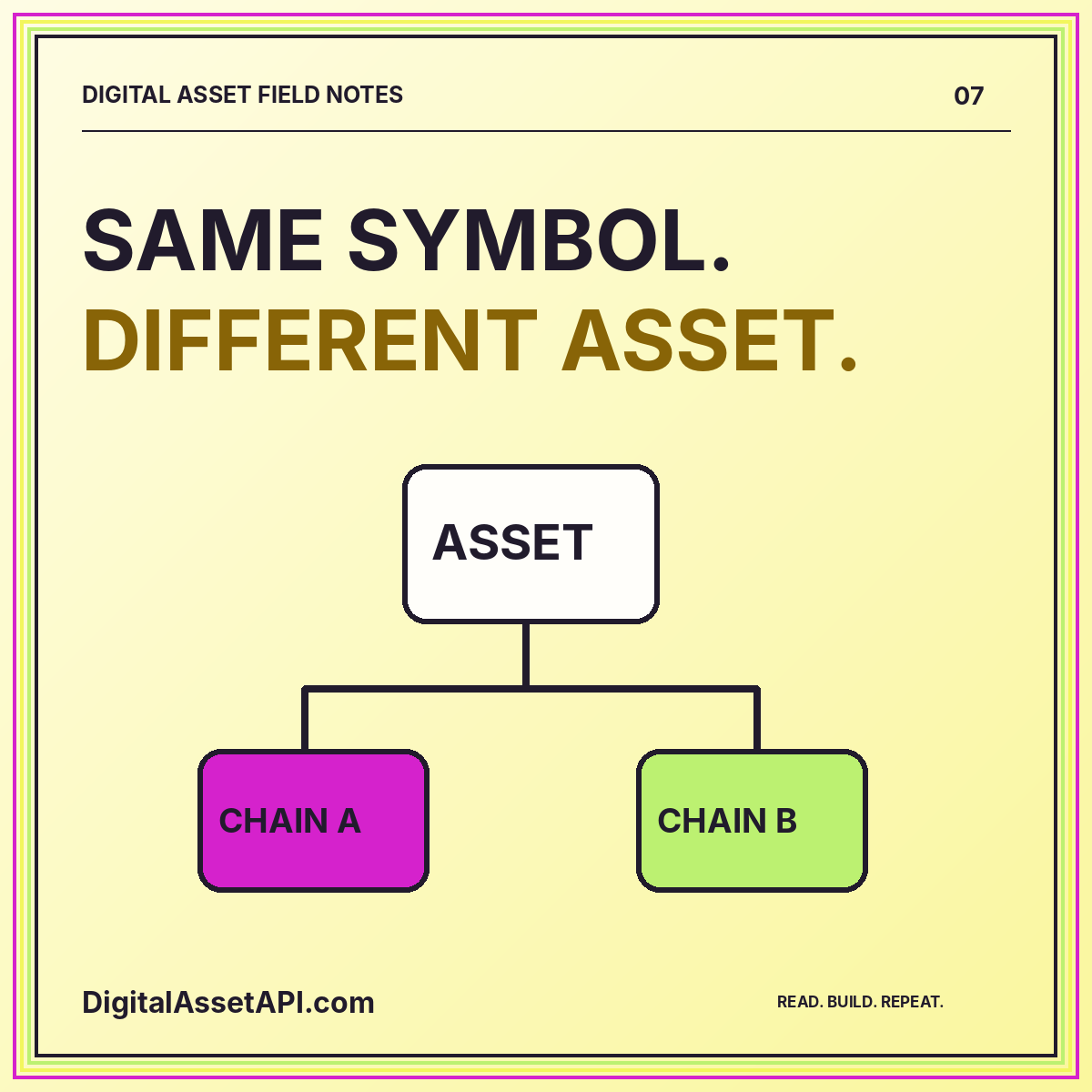
Give each resource a stable identifier that is independent of its display name. A token symbol is a label, not a reliable database key. Preserve the provider's original identifier alongside your internal identifier so an operator can trace a normalized record back to its source. Keep aliases separate from identity, especially when a project changes its name or ticker.
Preserve units without losing precision
Represent raw token quantities as integer strings in JSON when they could exceed the exact integer range of a consumer's number type. Carry the decimal scale as a separate field and format values only for display. This is a design choice intended to avoid accidental rounding during interchange; each client still needs an appropriate exact-arithmetic implementation.
Consider a fictional token with six decimal places and a raw quantity of 1250000. The display quantity is 1.25, not 1,250,000. Keep those two representations visibly distinct in the schema. A missing decimal scale should produce an unresolved display state, not an automatic assumption. Do not silently borrow the scale from another token with the same symbol.
Treat time and coverage as first-class fields
An API response should distinguish the time an event occurred, the time the upstream system observed it, and the time your application fetched it. Those timestamps answer different questions. A recent fetch does not prove that the underlying information is recent. Include a coverage state such as complete, partial, or unavailable, with a reason that users can understand.
For a multi-account dashboard, return coverage per account rather than attaching one reassuring timestamp to the entire page. Imagine two accounts refreshed successfully while a third timed out. Your application can show the available observations, but its total should be labeled partial. A timeout must not become a zero balance merely because the response parser expects a number.
Design pagination around reproducibility
History endpoints need a rule for stable ordering. In our reference design, use a cursor tied to a documented sort order and, where possible, a fixed observation boundary. Otherwise, new records arriving between requests can shift page boundaries and cause duplicates or omissions. A cursor should remain opaque to clients rather than becoming an invitation to guess internal database positions.
Test an import with a page boundary that falls between two records sharing a timestamp. Then add a new event during the import. Can the client resume without losing or counting a record twice? Document cursor expiration, maximum page size, and the process for restarting a historical import. These details matter more to operational reliability than an attractive endpoint name.
Make errors useful without exposing secrets
A useful error explains the category, whether retrying is sensible, and how to identify the failed request. Distinguish an unsupported network from an invalid identifier, an authorization failure, and a temporarily unavailable provider. Do not return success with an empty array when the real condition is a failed upstream call. Empty data and missing data are different states.
Give users a safe request reference they can share with support. Keep authentication headers, signing material, and sensitive account metadata out of error messages. For retryable failures, use a bounded backoff policy and respect provider instructions. A retry loop without a deadline can consume resources indefinitely while making the interface appear to be continuously working.
Review a concrete balance response
A useful balance observation might include an asset identifier, a raw amount, decimal scale, network identifier, block reference, observation time, fetch time, and coverage status. An optional display amount is a convenience, not a substitute for the original quantity. A fiat estimate belongs in a separate valuation object with its own currency, source, timestamp, and methodology.
Suppose the token balance is available but the price provider is not. Show the quantity and an unavailable valuation state. Do not set the market value to zero, and do not hide the whole record. This separation lets the interface preserve what it knows without pretending it knows everything. The API playbook includes copyable reference payloads built around this distinction.
Compare providers with failure scenarios
Ask prospective providers how they report incomplete indexing, unsupported assets, removed events, pagination boundaries, and planned schema changes. A coverage table is more useful than a broad claim of multichain support. Specify the networks, historical ranges, resource types, and freshness requirements your application actually needs before comparing prices or response times.
Build a small evaluation set with a known empty account, an unsupported asset, a stale observation, a failed request, and a long transaction history. Record the expected outcome for each case. Evaluate correctness and diagnosability before optimizing speed. A fast response that erases uncertainty can be harder to repair than a slower response that tells the truth.
Ship a narrow interface you can explain
Before release, ask somebody outside the integration team to explain every number on the screen. They should be able to find its unit, source, observation point, and limitations without reading code. Use the data-quality checklist to turn those questions into acceptance criteria, then review the webhook reliability guide when adding event-driven updates.
A dependable digital asset API is not defined by how many methods it exposes. It is defined by whether consumers can understand and reproduce its answers. Start with precise identities, exact quantities, explicit coverage, and honest failure states. Those foundations make later additions easier to review because every new feature has to preserve the same clear contract.