A webhook tells your application that something may have changed. It should not be treated as a magical guarantee that your local data is complete, correctly ordered, and permanently settled. For digital asset systems, that distinction matters because an incoming notification may describe an observation whose interpretation changes after additional evidence arrives.
This guide proposes an event-ingestion design for a fictional read-only asset monitor. It explains how to receive notifications, record them durably, process them without repeated business effects, and recover after interruptions. The example is an architectural pattern, not an implementation of a hosted DigitalAssetAPI.com endpoint. Provider-specific delivery contracts still need to be checked directly.
Begin with the provider's delivery contract
Before writing a handler, document what your provider promises about retries, ordering, event identifiers, signature verification, and event history. Do not assume two services behave identically because both send JSON over HTTP. An event identifier might identify a delivery attempt in one system and a business event in another, which changes the appropriate deduplication strategy.
Read the primary reference
As a concrete reference, Stripe documents retries, duplicate events, signature verification, and the absence of a guaranteed delivery order in its webhook system. Its webhook documentation is the primary source for those Stripe-specific behaviors. We use those lessons as a design comparison, not as evidence that a blockchain provider follows Stripe's exact timing or verification scheme.
Separate receipt from processing
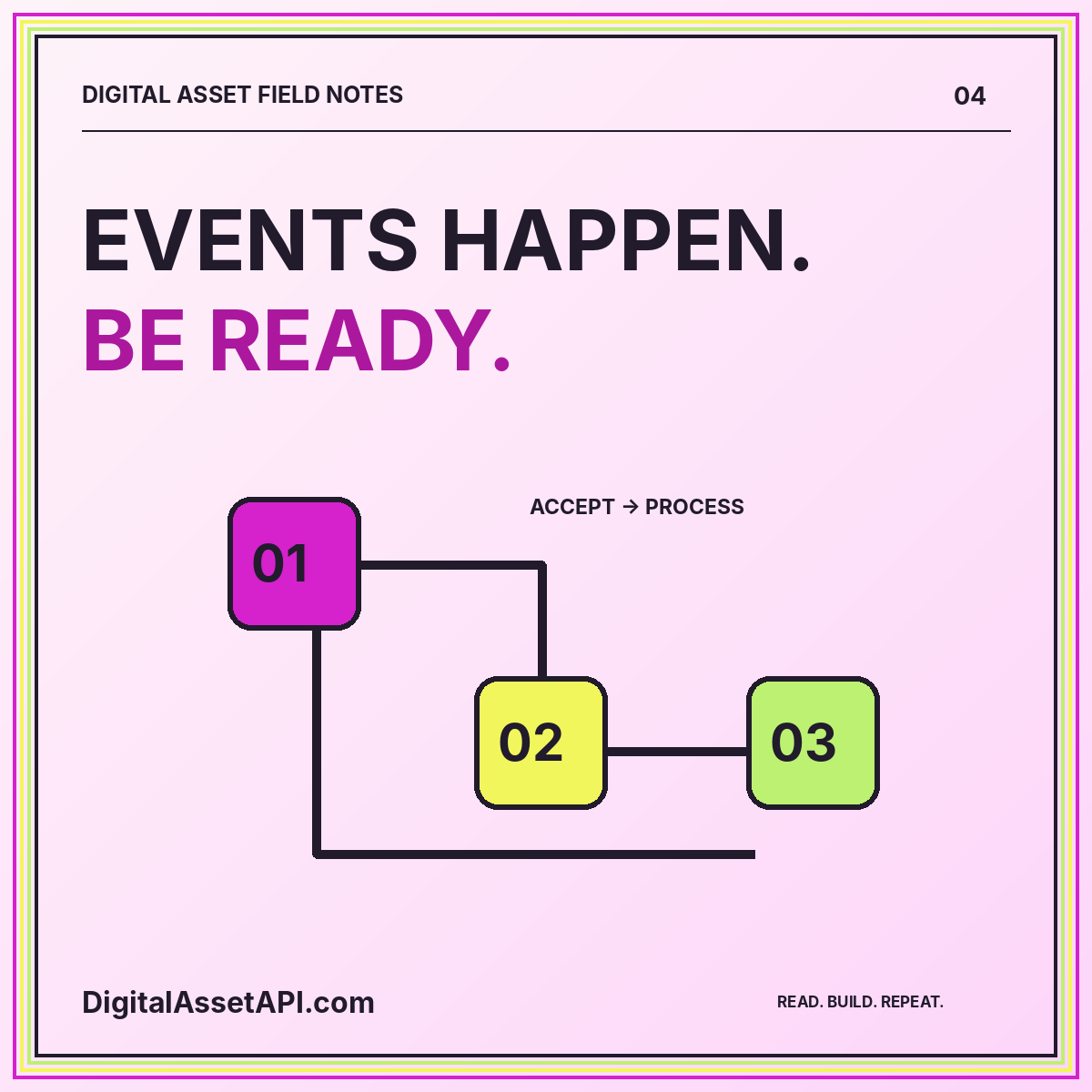
Keep the network-facing handler small. In our proposed design, it checks the request against the provider's documented verification method, validates a bounded envelope, and writes an accepted event to durable storage. A worker then performs the slower business processing. The handler acknowledges success only after the system has a reliable record to continue from.
This separation gives the application a clearer failure model. If downstream enrichment is unavailable, the accepted event remains queued rather than disappearing with an HTTP timeout. If durable storage is unavailable, the handler should not pretend the event was safely accepted. Define the actual acknowledgement behavior in line with the provider's retry contract and your infrastructure.
Verify the request without rewriting its evidence
Some providers verify signatures against the original request bytes. A framework that parses and reserializes JSON before verification can therefore break the documented process. Preserve the representation required by your provider, and use its supported verification library or a carefully reviewed implementation. Do not invent a homemade signature format just because the request looks familiar.
Keep secrets in a managed server-side configuration, not in a public page or source repository. Plan rotation and overlap behavior before changing a signing secret. Verification failures should create safe diagnostic records without copying sensitive headers into general logs. Distinguish an invalid signature from an internal verification outage so operators can investigate the right problem.
Give every event a durable identity
Store the provider, account scope, event identifier, event type, received time, and original evidence needed for investigation. Use a uniqueness constraint that reflects the provider's identifier semantics. A global event identifier may be sufficient for one service; another may require a compound key. Document the choice instead of relying on an accidental database behavior.
Delivery attempts should be recorded separately from the logical event. The same event may arrive repeatedly while still requiring only one business effect. Keeping both records lets operators see delivery problems without confusing them with additional asset movements. It also makes replay safer because the application can identify previously accepted events before applying changes.
Make the business effect idempotent
Idempotency means repeated processing of the same intended operation does not keep adding the same effect. An in-memory flag is not enough when multiple workers or restarts are possible. In our reference design, a database transaction or equivalent durable coordination ties the processing marker to the state change. The exact mechanism depends on the storage system.
Consider a fictional deposit observation that updates a local activity feed. A worker writes the feed entry and then crashes before acknowledging its queue message. On retry, the operation should find the existing effect and avoid adding another entry. Test the crash at each boundary, including before the write, during the transaction, and immediately after commit.
Expect events to arrive out of order
Never let arrival time alone determine the current business state. An older observation arriving late should not overwrite a newer, better-supported observation merely because it was processed last. Where a provider supplies versions, sequence information, or authoritative resource retrieval, use the documented semantics to decide how to reconcile the event.
For the fictional monitor, we treat notifications as prompts to refresh the affected resource when appropriate. That choice simplifies some ordering problems but introduces rate and availability constraints. It is a tradeoff, not a universal best practice. Preserve the notification and the resulting observation separately so an operator can explain which evidence produced the displayed state.
Keep chain observations revisable
A chain-related notification should carry enough context to identify the network, relevant block, and observed object. Do not strip those fields during normalization merely because the user interface initially shows only a short status label. A later correction may need to refer to the exact earlier observation that is being replaced or invalidated.
Define how your application handles a removed, superseded, or unresolved observation according to the provider and network you use. The local ledger should not silently erase history. A compensating record or versioned correction can preserve the original evidence and explain the current interpretation. The API architecture guide develops this separation between observations and conclusions.
Design retries with an end condition
Use bounded retry policies for transient processing failures. Distinguish a temporary dependency outage from a permanently invalid payload or unsupported schema version. Retrying a malformed event indefinitely creates noise and can delay valid work. Route unresolved events to an investigation queue with a clear reason and enough non-sensitive evidence to reproduce the problem.
Set an owner for that queue. A dead-letter store without an operational process is only a quieter form of data loss. Define how events are reviewed, corrected, replayed, or explicitly rejected. Measure the age of the oldest unresolved event and the number of affected resources, not just the total number of successful HTTP responses.
Reconcile beyond the webhook channel
A reliable design needs a way to compare its local state with an authoritative source after an outage. Depending on the provider, that may involve an event history endpoint, a bounded resource rescan, or a periodic snapshot. Document the historical coverage and retention window so operators know when automated recovery can no longer reconstruct the gap.
Run a recovery exercise in which delivery stops for a known interval. Record which events were missed, how the application identifies the gap, and how it restores coverage without duplicating effects. The data-quality checklist includes useful questions about partial coverage and stale observations. A green delivery dashboard is not proof that your dataset is complete.
Test the lifecycle, not only the happy path
Your test set should include a valid event, an invalid signature, a duplicate, an out-of-order pair, a worker crash, an unavailable database, a schema change, and a replay after recovery. For each case, specify the expected acknowledgement, stored evidence, business effect, and operator action. This turns vague reliability expectations into reviewable behavior.
Start with a narrow event type and expand after the recovery process works. Use the API playbook as a vocabulary reference, not a live delivery service. The core principle is straightforward: a notification is evidence to process, not permission to skip verification, reconciliation, or uncertainty. A well-designed webhook pipeline makes repeated and interrupted work explainable.