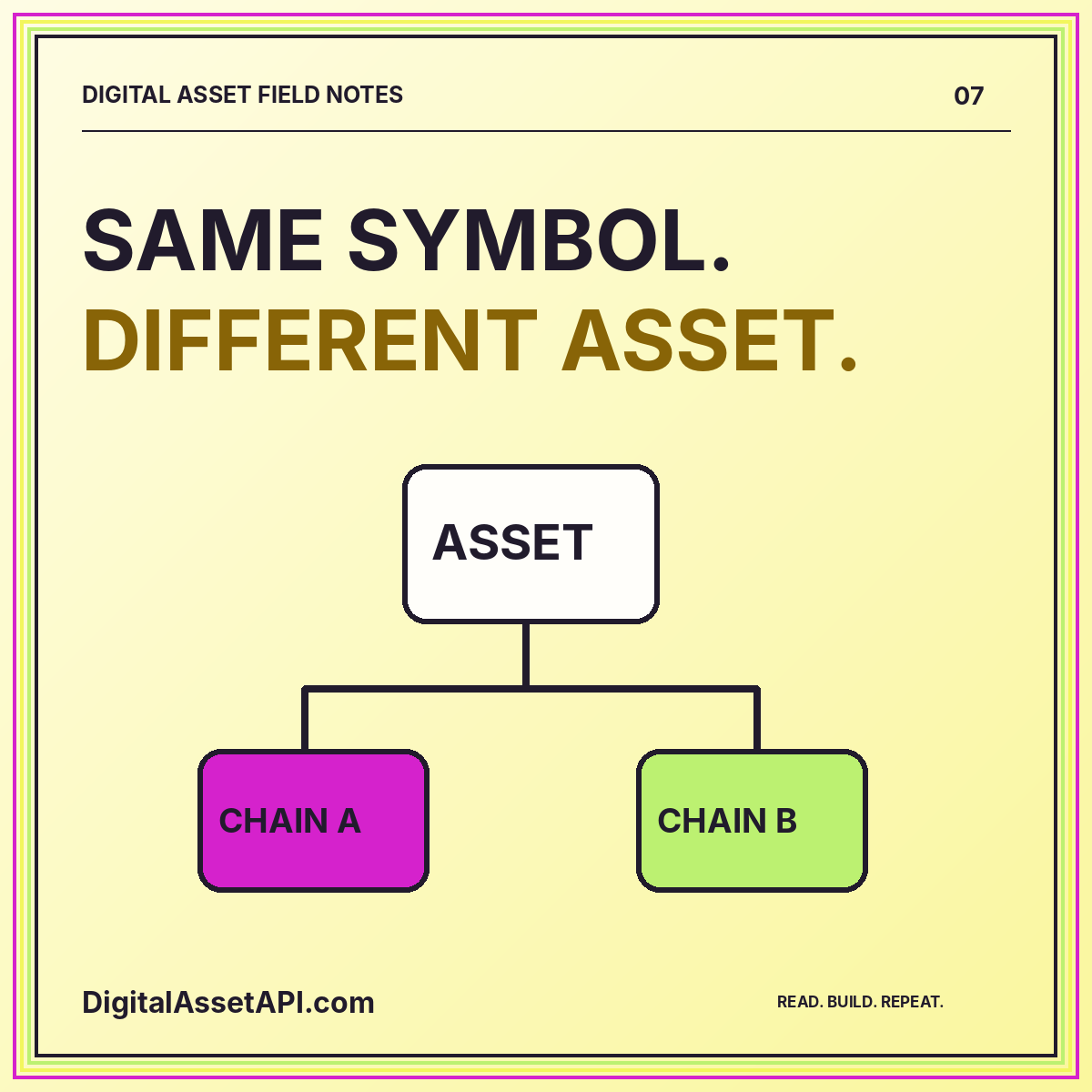
Two assets can share a name and still be entirely different instruments. A token symbol can appear on several networks, a project can migrate to a new contract, and an application can accidentally mix test data with production data. When a dashboard identifies assets by label alone, those ordinary situations become difficult to detect and expensive to untangle.
This guide develops a practical asset-identity model for a fictional multichain catalog. It focuses on identifiers, metadata, aliases, and versioned relationships. The proposal is intended for product and engineering review, not as a claim that every network uses the same address format or that a standardized identifier proves an asset is legitimate, valuable, or safe.
Separate identity from presentation
An identifier answers which object a record refers to. A display name answers how a person should read it. Keep those responsibilities separate. Names, symbols, icons, and descriptions can change without changing the object itself. Conversely, two distinct objects can use the same presentation. A friendly interface should never require its database to ignore that distinction.
In the proposed catalog, each asset receives an internal stable record identifier and preserves the external identifiers used by its sources. The internal identifier is not a replacement for the external evidence. It is a way to join observations consistently while keeping the network, contract, or native-asset reference available for inspection and reconciliation.
Understand what CAIP-19 contributes
CAIP-19 defines a structured way to identify asset types using a chain identifier and an asset namespace and reference. It also supports an additional identifier for individually addressable assets such as NFTs. The specification discusses syntax and canonicalization considerations, which matter when software compares identifiers from different sources.
Read the primary reference
The CAIP-19 asset identification specification is the primary reference for that format. A conforming identifier describes an identity; it does not certify economic equivalence or trustworthiness. The catalog practices below are our implementation recommendations, and integrations still need to verify the rules for each relevant namespace and network.
Make the network part of the key
A contract reference should be interpreted within its network context. Do not assume an address-shaped string identifies the same asset everywhere it appears. The catalog should require an explicit network identifier before accepting a contract-based asset record. A missing network is an unresolved identity, not an invitation to choose the most familiar chain.
Keep test and production networks separate in both storage and presentation. For a fictional token named SAMPLE, the catalog might contain distinct test-network and production-network records. Their matching names should not cause automatic merging. When exporting data for another team, include the network context in the exported identifier so the distinction survives outside the original interface.
Distinguish native assets from contract tokens
Do not force every asset into a contract-address field. A native network asset and a contract-based token may require different identification conventions. Use a typed identity structure that records which kind of reference is present. That makes unsupported combinations easier to reject and avoids magical placeholder addresses that only one integration happens to understand.
For example, a balance response could identify its network, asset namespace, reference, and asset class separately from its display symbol. The exact field names are your application's design choice. The important point is that a consumer can determine how the identity should be interpreted without guessing from the length of a string or the presence of a familiar ticker.
Preserve the original identifier during normalization
Normalization can make comparison easier, but it should not erase the source representation. Store the original input, the normalized form, the normalization rule, and its version where relevant. This gives operators a way to investigate disagreements between systems and makes future migrations more manageable when an identifier rule changes.
Avoid globally lowercasing all identifiers. Some formats have case-sensitive semantics or checksum conventions, while others have different canonicalization rules. Apply only the rules documented for the relevant namespace. When the software cannot establish a valid normalized form, retain the evidence and mark the record unresolved rather than producing a plausible-looking key.
Treat metadata as observed information
A name, symbol, decimal scale, image URL, and description should carry provenance. Record where each field came from and when it was observed. Different providers can disagree, and a metadata response should not be treated as an authoritative endorsement of an asset. Separate descriptive metadata from your own classification or review decisions.
Decimal scale deserves special attention because it affects displayed quantities. An unknown scale should not silently default to a familiar value. Show the raw quantity and an unresolved display state when appropriate. The digital asset API guide explains how integer quantities and explicit scales reduce ambiguity when balances move between systems.
Model migrations as relationships
When an asset moves to a new contract, create a new identity record and describe the relationship to the old one. Record the supporting source, effective dates, and any limitations. Do not overwrite the old address in place, because historical observations still refer to the earlier instrument. A migration announcement is information to evaluate, not an automatic instruction to merge balances.
Similarly, wrapped and bridged representations should remain separate assets unless your application has a specific, documented reason to aggregate them for a particular view. Even then, preserve the underlying records and explain the aggregation. “Related exposure” is a reporting relationship, not proof that two instruments have identical rights, liquidity, or operational behavior.
Build a conflict-resolution workflow
A catalog should expect duplicate candidates, conflicting metadata, unsupported namespaces, and incomplete source records. Give those cases explicit statuses and review paths. An automated import should not resolve uncertainty by selecting whichever provider responded first. Keep enough evidence for a reviewer to understand why the conflict exists and what decision was made.
For a fictional conflict, Provider A calls an asset SAMPLE and Provider B calls it Sample Credit. If both refer to the same verified network and contract identity, the disagreement may be presentational. If the contracts differ, the matching symbol is not enough to merge them. Write those rules as testable cases rather than informal team knowledge.
Handle media and descriptions as untrusted content
Asset metadata can include text and remote media references. A catalog should not inject those values into HTML without appropriate handling. Keep descriptions as text unless a reviewed rendering policy allows more. Apply a deliberate policy to remote media, including allowed schemes, size limits, and whether the application loads it directly or through a controlled process.
The goal is not to imply that every metadata field is malicious. It is to keep external presentation data from gaining capabilities it does not need. A token description should not be able to execute code, change the page's navigation, or impersonate the site's own notices. The API security guide expands on treating upstream data as untrusted input.
Test the catalog with collisions
Create test cases with identical symbols on different networks, identical-looking contract references in different contexts, missing decimal scales, renamed assets, and an announced migration that has not been reviewed. Verify that observations remain attached to the correct identity and that the interface clearly distinguishes confirmed mappings from unresolved candidates.
Use the data-quality checklist to review your acceptance criteria. A multichain catalog becomes useful when it preserves context rather than hiding it. Stable identifiers, explicit namespaces, versioned relationships, and field-level provenance let your application grow without relying on the fragile assumption that a familiar name always refers to the same thing.